Publisher Rocket vs Helium 10 (2026): Which Is Better for Amazon KDP?
If you publish books on Amazon, you already know the problem. Amazon doesn’t tell you what readers actually search for. You’re guessing or you’re paying for a tool that claims to know.
Publisher Rocket and Helium 10 are the two names that come up most in every KDP keyword research conversation. But they weren’t built for the same job, and that difference matters more than any feature list. This guide breaks down Publisher Rocket vs Helium 10 for Amazon KDP specifically real numbers, real pricing, and an honest verdict instead of a sales pitch.
Publisher Rocket vs Helium 10: Quick Overview for KDP Authors
🎁 Download 15 FREE KDP Interior Templates
Save time and create beautiful low-content books faster with these 15 ready-to-use KDP interiors — completely free! Perfect for journals, planners, and activity books.
Publisher Rocket (previously called KDP Rocket) was built from day one for authors. Dave Chesson of Kindlepreneur designed it to answer one question: what keywords and categories will get a book in front of readers on Amazon?
It’s a desktop app for Mac and Windows, and its entire feature set including keyword search, category search, competition analysis — points at books.
Helium 10 started life as a toolkit for Amazon FBA sellers moving physical products. Think kitchen gadgets, supplements, pet toys. Its keyword tools (Cerebro and Magnet) are genuinely powerful, but they were designed to filter product data, not book metadata. Authors use it, but they’re borrowing a tool built for someone else’s business model.
That origin story explains almost every difference you’ll see in this comparison.
| Factor | Publisher Rocket | Helium 10 |
|---|---|---|
| Platform | Desktop app (Mac/Windows) | Web app + Chrome extension |
| Built for | Book authors and publishers | Amazon/Walmart product sellers |
| Pricing model | One-time payment | Monthly subscription |
| Learning curve | Low | Moderate to steep |
| Marketplaces covered | US, UK, Germany | Much wider, product-focused |
Publisher Rocket vs Helium 10 for KDP Keyword and Niche Research
This is where the real decision gets made, so let’s look at how each tool actually performs on the same search.
Publisher Rocket’s Keyword Search, Category Search, and Reverse ASIN
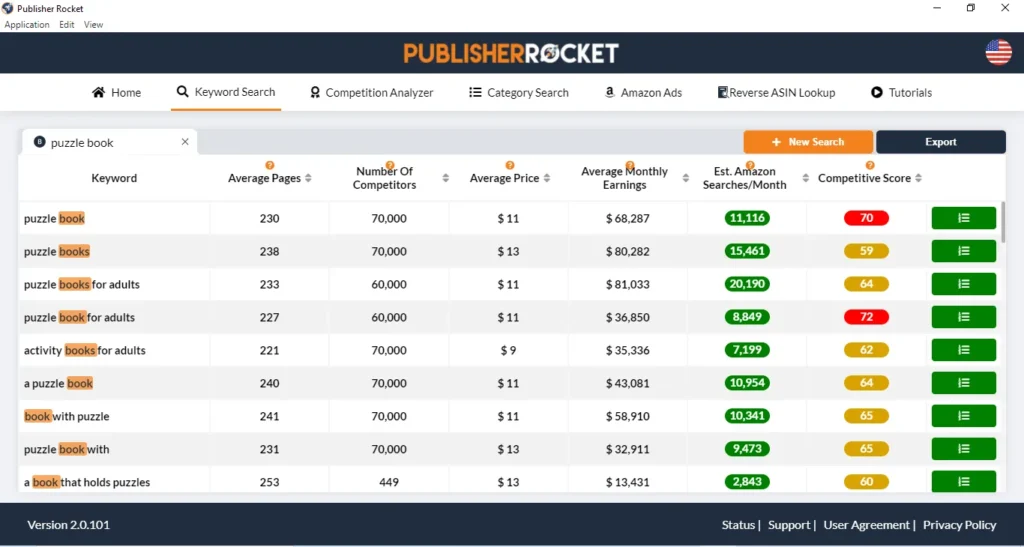
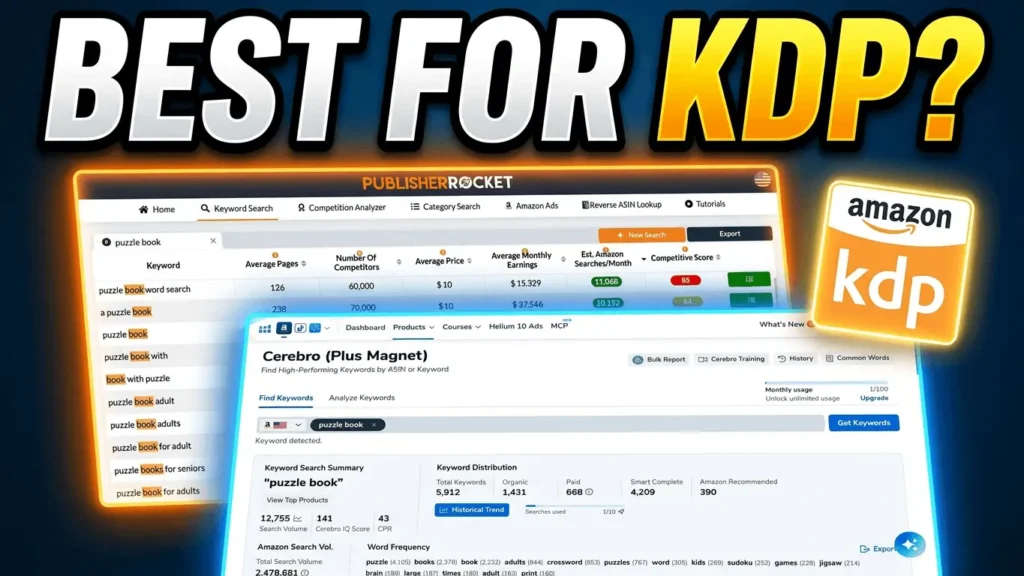
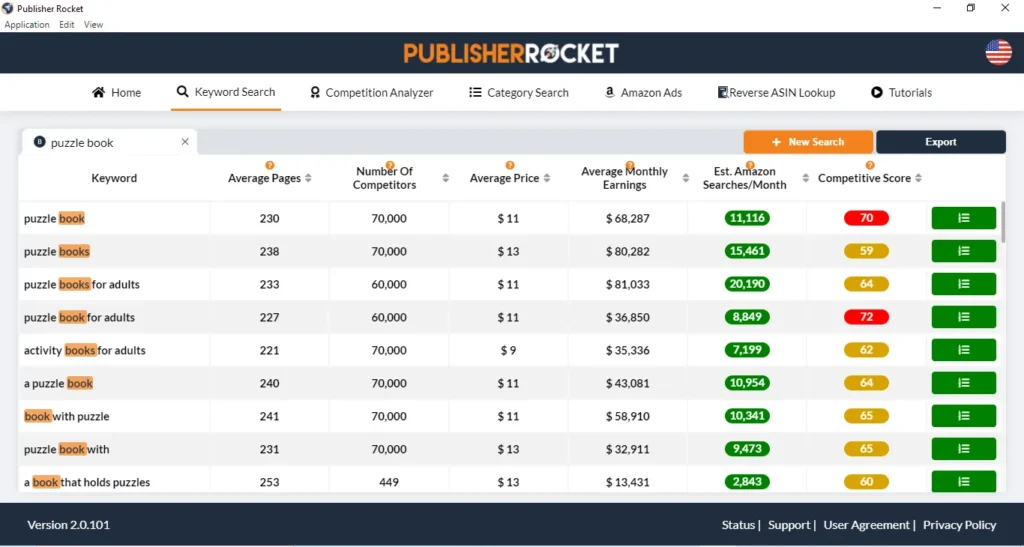
Type a seed phrase — “puzzle book,” for example — into Publisher Rocket’s Keyword Search tool, and it pulls back a full list of related phrases. Each one comes with estimated monthly Amazon searches, the number of competing books, average list price, average monthly earnings, and a competitive score from 0 to 100. Green means low competition, orange means medium, red means high.
The Category Search tool maps over 19,000 Amazon categories and shows exactly how many daily sales you’d need to hit a #1 bestseller badge in each one a number most authors would otherwise never see. Reverse ASIN lets you paste a competitor’s book link and instantly see every keyword that book ranks for, which is one of the fastest ways to reverse-engineer a profitable niche.
Helium 10’s Cerebro, Magnet, and Black Box for Book Keywords
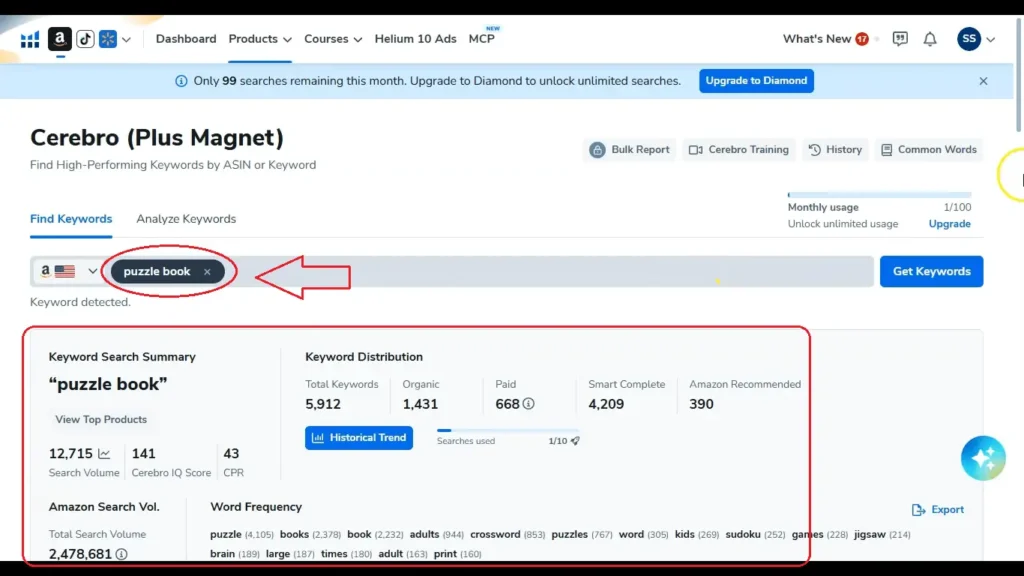
Cerebro is Helium 10’s reverse-ASIN tool, and it’s deep. Run the same “puzzle book” seed keyword, and Cerebro returns thousands of related keywords — sometimes close to 6,000 for a single niche — along with search volume, a proprietary Cerebro IQ Score (search volume weighed against competing products), and search volume trend data showing whether a keyword is rising or falling.
Magnet builds keyword lists from a broad seed phrase, while Black Box lets you filter by category, price, review count, and monthly revenue to surface entire book niches, not just single keywords.
A Real Side-by-Side Example
Numbers tell the story better than feature lists. Testing the keyword “puzzle book” in both tools side by side:
In Publisher Rocket, “puzzle book” showed roughly 11,116 estimated monthly searches, over 70,000 competing books, and a competitive score of 70 (high competition). Narrowing to a longer phrase like “book with puzzle” dropped competition to under 241 books while still pulling in over 10,341 monthly searches, a far stronger opportunity.
In Helium 10’s Cerebro, the same seed keyword returned a total search volume of 2.4 million across all related terms, with the core phrase alone showing roughly 12,715 monthly searches and a Cerebro IQ Score of 141.
After filtering for a minimum 500 search volume and under 3,000 competitors, the keyword list dropped from thousands down to a manageable 55 options.
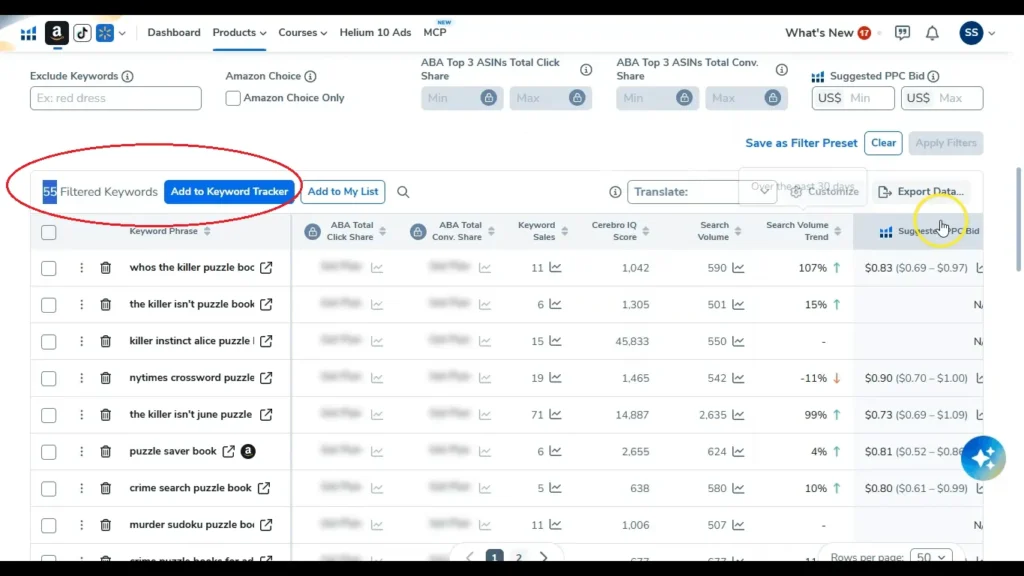
Both tools agree on the underlying demand. The difference is depth: Helium 10 surfaces a far larger raw keyword universe, while Publisher Rocket gets you to a usable, book-ready shortlist faster.
Publisher Rocket vs Helium 10 Pricing: Which Costs More Long-Term?
Publisher Rocket Pricing (2026)
Publisher Rocket is a one-time purchase of $199 (the price rose from its long-standing $97 point in recent years). That single payment includes lifetime updates and a 30-day money-back guarantee. There’s no free trial, but the refund window removes most of the risk.
Read My Publisher Rocket Review: Publisher Rocket Review: Finding Low-Competition Amazon KDP Niches (2026)
Helium 10 Pricing (2026)
Helium 10 runs on a subscription model. Its Platinum plan currently sits around $129 per month, or roughly $99 per month when billed annually. A limited free plan exists, but it caps the features you’ll actually need for serious keyword research.
👉 If you want to go deeper into KDP niche & keyword research, check out my complete guide on finding low-competition Amazon KDP niches using Helium 10. In this step-by-step tutorial, I show exactly how to uncover profitable book ideas, validate demand, and analyze competition before you publish.
One-Time vs. Subscription: The Real Cost Comparison
Run the math over a single year, and the gap is hard to ignore. Twelve months of Helium 10 Platinum at the annual rate costs close to $1,188 — nearly six times Publisher Rocket’s one-time $199 fee. Stay subscribed for two years, and you’ve spent enough to buy Publisher Rocket almost twelve times over.
For an author publishing a handful of books a year, that math rarely favors Helium 10 — unless the subscription is already justified by a separate, physical-product business.
Beyond Keywords: Ease of Use, Amazon Ads, and Support
Ease of Use for Beginners vs. Experienced Sellers
Publisher Rocket’s interface is built around four clear features, and most authors feel comfortable navigating it within a couple of hours. Helium 10’s dashboard holds dozens of tools built for an entirely different workflow — inventory, PPC, profit tracking — so new users often describe an initial learning curve before the platform clicks.
AMS Keywords vs. PPC and Listing Tools
Publisher Rocket’s AMS Keywords feature generates Amazon Ads keyword lists in seconds, built specifically around bestsellers, new releases, and “customers also bought” data in your genre. Helium 10 counters with a far broader PPC management suite and an AI Listing Builder, better suited to sellers running ad campaigns across many products, not just book metadata.
Customer Support Compared
Both platforms offer responsive support — Publisher Rocket through a tutorial library and ticket system with typical replies within 24 hours, Helium 10 through live chat, a help center, and an active user community. Neither is a weak point; the difference is scale, not quality.
Publisher Rocket vs Helium 10: Which Should You Choose for KDP?
Choose Publisher Rocket if you publish books as your primary (or only) business, want a one-time payment with no recurring bill, and need focused keyword, category, and AMS research without wading through unrelated tools.
Choose Helium 10 if you’re already running — or planning to run — a broader Amazon business that includes physical products, and the subscription cost is justified by that wider use, not by book research alone.
You might need neither if you’re publishing your first book on a tight budget. Amazon’s own search bar and Google Keyword Planner are free, and they’re built on real search data rather than estimates. If both tools still feel like overkill once you’ve outgrown the free route, author-specific alternatives like Book Bolt sit in between more affordable than Helium 10, more niche-focused than Publisher Rocket.
The Bottom Line
For most Amazon KDP authors, Publisher Rocket wins on focus, simplicity, and long-term cost. Helium 10 earns its place only when your business extends beyond books into the wider Amazon marketplace. Either way, test the free research methods first — they’re often enough to get your first book off the ground.
FAQ: Publisher Rocket vs Helium 10 for Amazon KDP
What Is the Difference Between Publisher Rocket and Helium 10?
Publisher Rocket is built specifically for book authors, with keyword, category, and AMS ad research for Amazon KDP. Helium 10 is a broader Amazon seller platform originally designed for physical product sellers, with book-relevant tools (Cerebro, Magnet) included as part of a much larger suite.
Is Publisher Rocket or Helium 10 Better for Amazon KDP?
For KDP specifically, Publisher Rocket is generally the better fit because every feature is built around books. Helium 10 is stronger only if you also sell physical products and want one platform for everything.
Can You Use Helium 10 for Amazon KDP Keyword Research?
Yes. Cerebro and Magnet both return usable keyword and search volume data for books. The tradeoff is that Helium 10 doesn’t separate book keywords from product keywords, so you’ll spend extra time filtering irrelevant results.
Is Publisher Rocket Better Than Helium 10 for Finding Profitable Book Niches?
Publisher Rocket’s Category Search and Competition Analyzer are purpose-built for niche validation in books, including bestseller sales thresholds by category. Helium 10’s Black Box can find niches too, but its filters are tuned for products, not genres.
Which Tool Offers More Accurate Amazon Keyword Search Volume Data?
Neither tool pulls exact numbers directly from Amazon — both rely on estimates built from autocomplete data, sales patterns, and modeling. Treat the figures as comparative signals (which keyword is stronger than another), not as guaranteed exact search counts.
How Much Do Publisher Rocket and Helium 10 Cost?
Publisher Rocket costs $199 one-time, with free lifetime updates. Helium 10’s Platinum plan costs about $129 per month (roughly $99/month billed annually).
Is Helium 10 Worth It for KDP Publishers, or Is Publisher Rocket Enough?
For authors focused only on books, Publisher Rocket’s one-time price typically covers everything needed for keyword and category research. Helium 10 becomes worth it only when its broader Amazon toolset — beyond books — is part of your business.
My Recommended KDP Masterclass 2026 💡
KDP Masterclass By Self Publishing Titans
I absolutely love this Masterclass because it’s one of the most up-to-date and practical KDP courses available. The creators aren’t just teachers — they’re real KDP publishers who’ve earned over $300K in book royalties! 📚 I personally took this class and noticed a steady increase in my KDP sales over time. If you’re serious about growing your publishing business in 2026, this course is a total game changer.