Gumroad Pay What You Want Strategy: Digital Products Case Study
How a simple KDP template bundle quietly crossed its first
passive income milestone!
Three years ago, I spent a few hours putting together a template bundle for KDP publishers. I uploaded it to Gumroad, set it to “pay what you want,” and largely moved on.
I never ran ads for it. I mentioned it on my YouTube channel a couple of times and wrote about it on my blog. That was the extent of my marketing.
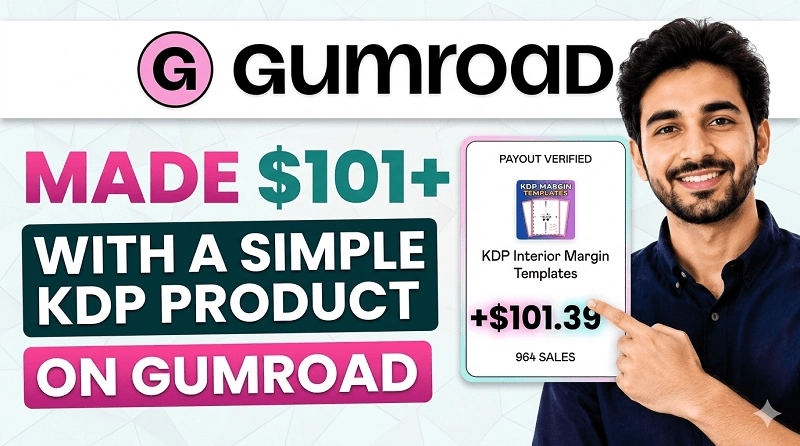
This month, it crossed $101 in earnings. 964 sales. Still getting downloads.
I’m sharing this not because $101 is a life-changing number, but because the story behind it says something important about how free digital products actually work.
👉 Download Now: Free Gumroad Starter Checklist
🎁 Download 15 FREE KDP Interior Templates
Save time and create beautiful low-content books faster with these 15 ready-to-use KDP interiors — completely free! Perfect for journals, planners, and activity books.
Why I Created It in the First Place
If you’ve ever formatted a book for Amazon KDP, you already know the frustration. Your interior looks fine in your editor. You upload it. KDP rejects it because your content is outside the defined margins.
It’s one of the most common beginner mistakes in self-publishing, and it trips up new authors constantly.
I had dealt with this myself and figured the simplest solution was to work inside a template that already had the correct margins built in. So I created four of them: 6×9 and 8.5×11 inches, each with a bleed and no-bleed version, covering up to 150 pages.
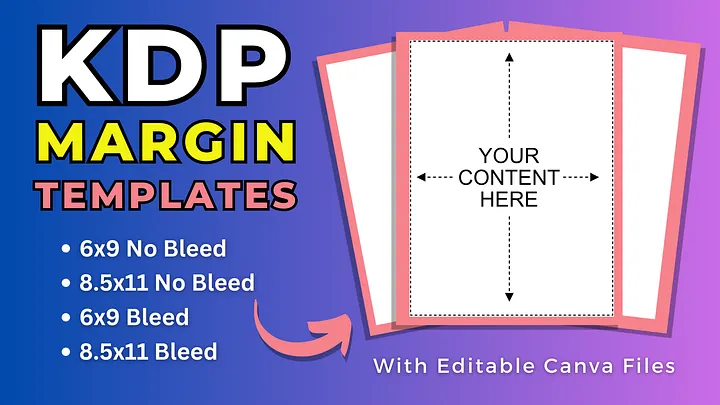
I included fully editable Canva source files so people could actually customize them rather than just stare at a static PDF.
The product wasn’t complicated. It solved one specific problem. That was the whole idea.
👉 Want to create and sell digital products online? check this easy-to-follow step-by-step blog post: How to Sell Digital Products on Gumroad and Earn Passive Income Online
What “Pay What You Want” Actually Did
Setting the price to pay what you want on Gumroad meant the product was essentially free, with an open door for anyone who wanted to contribute something.
Most people paid nothing. A handful paid a dollar or two. A few paid more. The distribution is what you’d expect from any PWYW product.
But here’s what I noticed over time: the volume more than compensated. When you remove the friction of a price tag from a useful resource, downloads accumulate steadily without you having to think about it.
964 sales over three years is roughly 320 per year, or about 26 per month, for something I built once and never touched again.
That’s not a business. But it’s a real demonstration of what low-friction digital products can do on their own.
👉 Want to launch your first digital product but don’t know where to start?
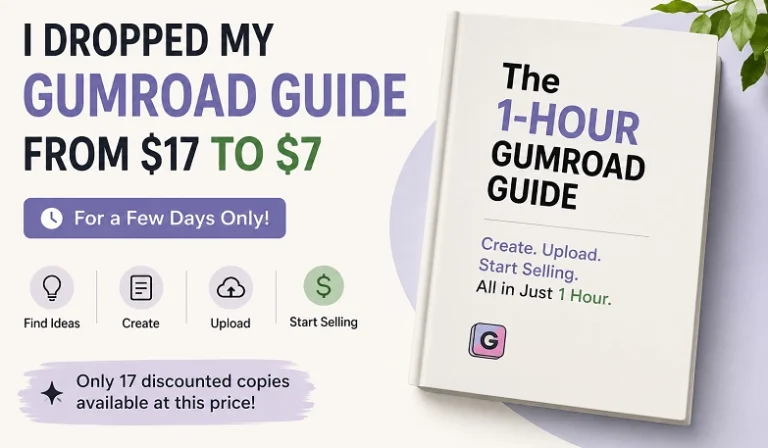
I’ve just released my brand-new guide: The 1-Hour Gumroad Guide, designed for aspiring digital product sellers who want to create and launch fast without overwhelm.
Inside, you’ll get my proven tips, tricks, and strategies to go from idea to your first sale in record time.
To celebrate the launch, it’s available at a special introductory price — plus you’ll get two invaluable bonuses that make starting even easier. 👉 Get it here
The Traffic Was Already There
I didn’t launch this into a void. I had a YouTube channel covering self-publishing topics and a blog where my audience was already asking about KDP formatting. When I mentioned the templates, the people watching and reading already had context for why they were useful.
This is the part that gets overlooked when people talk about passive income. The “passive” part only works if the traffic part was already solved, even partially.
A free product dropped into a warm audience with an existing problem will outperform a paid product dropped into silence.
My blog post and YouTube videos still brings in organic traffic. That post links to the template. The template keeps getting downloads. Nothing about that chain requires my attention anymore.
What Three Years of Slow Sales Teaches You
When I look at the sales graph, it’s not a viral spike followed by a slow fade. It’s just consistent, quiet movement. Some months are higher, some are lower, but it never fully stopped.
That pattern is more useful than a single big launch. It means the product found a permanent home in search results and recommendation threads. Someone finds a YouTube video about formatting and ends up on my Gumroad page. The product does its own quiet distribution.
$101 over three years is not impressive as a revenue number. But 964 people had their KDP formatting problem solved by something I spent a few hours building. That’s not a bad outcome for a freebie.
If You’re Thinking About Digital Products
The template bundle worked because it was specific, immediately useful, and required nothing from the buyer except downloading it. There was no onboarding, no learning curve, no setup. You open Canva, edit the margins if you need to, and get back to your book.
That’s the standard I try to apply to any digital product: can someone use this within five minutes of downloading it? If the answer is yes, you’re probably on solid ground.
If you want a practical starting point for creating and selling your own digital products, I put together a short guide called The 1-Hour Gumroad Guide that walks through the whole process from product idea to first sale. It’s designed for people who want to move fast and start simple.
👉 You can find it here: The 1-Hour Gumroad Guide
Start with something small. Something specific. Something you’ve already figured out and can package up for someone who hasn’t yet.
Three years from now, it might quietly cross a milestone of its own.
Thanks for reading it!
Talk soon,
Subha
My Recommended KDP Masterclass 2026 💡
KDP Masterclass By Self Publishing Titans
I absolutely love this Masterclass because it’s one of the most up-to-date and practical KDP courses available. The creators aren’t just teachers — they’re real KDP publishers who’ve earned over $300K in book royalties! 📚 I personally took this class and noticed a steady increase in my KDP sales over time. If you’re serious about growing your publishing business in 2026, this course is a total game changer.