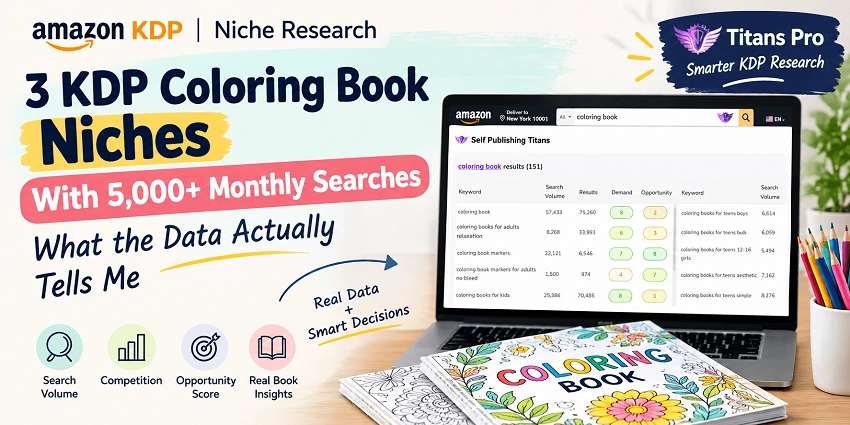
I Found 3 KDP Coloring Book Niches With 5,000+ Monthly Searches

I’ve been publishing on Amazon KDP since 2017, and one thing I’ve learned over the years is that KDP niche research can easily turn into a rabbit hole.
You find one promising keyword.
Then another.
Then you start checking competition, reviews, rankings, prices, and other books.
Before you know it, you’ve spent hours researching and still haven’t decided what to publish.
That’s why I like using actual data to narrow down my options.
Recently, I used Titans Pro to look at several coloring book keywords. Three of the keywords stood out because they showed estimated monthly search volumes above 5,000 and an opportunity score of 9/10.
But there’s an important lesson here:
A high search volume doesn’t automatically mean you have found a profitable KDP niche.
The rest of the data matters too.
Here are the three niches I looked at, in the order they appeared in my research.
🎁 Download 15 FREE KDP Interior Templates
Save time and create beautiful low-content books faster with these 15 ready-to-use KDP interiors — completely free! Perfect for journals, planners, and activity books.
1. Coloring Book for Teens 14–16 Girls
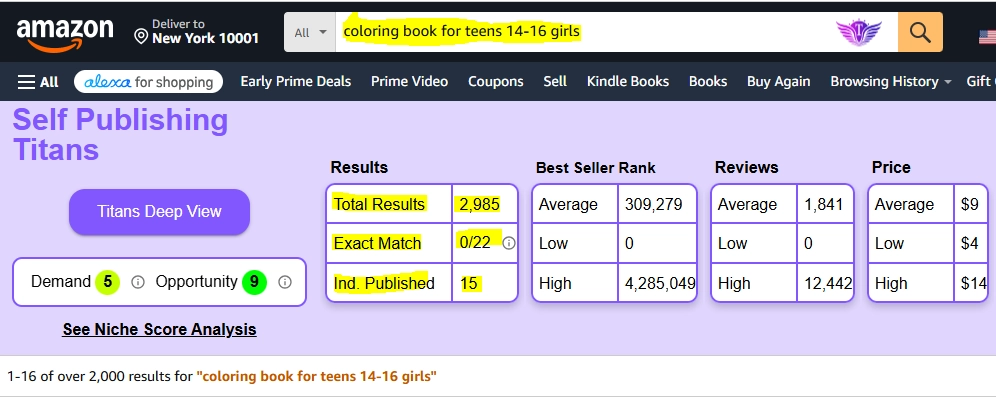
The first keyword was:
“coloring book for teens 14-16 girls”
Here is the data from Titans Pro:
| Metric | Data |
|---|---|
| Estimated monthly search volume | 5,496 |
| Total competing products | 2,985 |
| Demand score | 5/10 |
| Opportunity score | 9/10 |
| Exact-match books on first page | 1 |
| Independently published books on first page | 16 |
| Average BSR | 309,279 |
| Average reviews | 1,841 |
| Average price | $9 |
At first glance, the search volume is interesting.
An estimated 5,496 monthly searches suggests that people are actively searching for this type of product.
But the competition is also worth paying attention to.
There are approximately 2,985 competing products, so this isn’t a keyword where I would simply create a generic coloring book and assume the traffic will be enough.
One number I find particularly interesting is the number of exact-match books on the first page.
There is only 1 exact-match book.
That doesn’t mean competition is low overall. It simply tells us that Amazon’s first page isn’t dominated by books using the exact keyword phrase in their titles.
There are also 16 independently published books appearing on the first page.
That’s useful because it gives us actual books to study.
What are they doing differently?
What subjects and illustration styles are they using?
What do their covers look like?
What kind of reviews are they receiving?
And most importantly, is there an angle that I could execute better or differently?
The average review count is relatively high at 1,841, which also tells me that some established books in this market have accumulated substantial customer feedback.
So I wouldn’t treat this keyword as simply:
“5,496 searches = make a book.”
I’d treat it as a starting point for a deeper niche research.
How I Quickly Find Profitable KDP Niche Ideas Using Titans Pro
You may like this post where I shared a simple yet effective way I use to find low-competition, profitable KDP niche ideas fast!
2. Devotional Coloring Book for Women
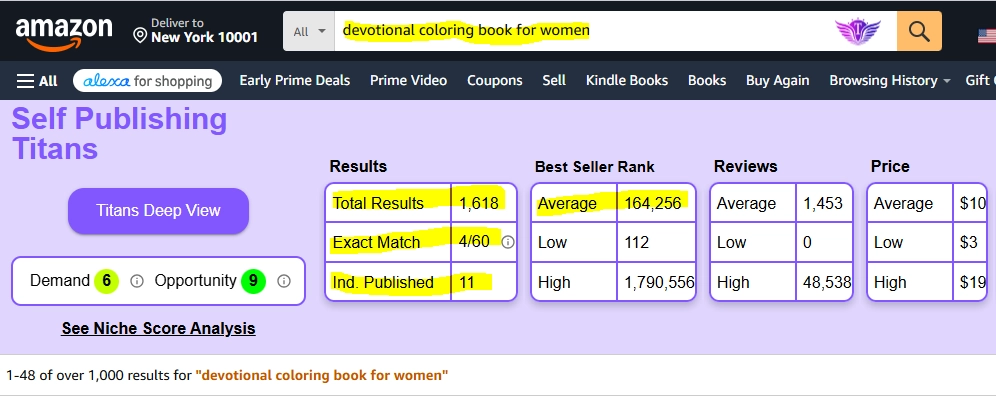
The second keyword was:
“devotional coloring book for women”
The Titans Pro data showed:
| Metric | Data |
|---|---|
| Estimated monthly search volume | 6,052 |
| Total competing products | 1,618 |
| Demand score | 6/10 |
| Opportunity score | 9/10 |
| Exact-match books on first page | 4 |
| Independently published books on first page | 11 |
| Average BSR | 164,256 |
| Average reviews | 1,453 |
| Average price | $10 |
This one immediately caught my attention because the estimated search volume is higher than the previous keyword:
6,052 searches per month.
At the same time, the reported competition is lower:
1,618 competing products.
Again, these numbers shouldn’t be interpreted as a guarantee of sales.
But they give us something useful to investigate.
There are also 4 exact-match books on the first page, compared with only 1 for the previous keyword.
That tells me the exact keyword is already being used more directly by some books ranking for the search.
The first-page data also shows 11 independently published books.
That gives a KDP publisher a useful group of real-world examples to study.
I’d want to look closely at those books before creating anything:
- What devotional themes are they targeting?
- What type of coloring pages do they contain?
- Are they combining coloring with scripture, prayers, reflections, or journaling?
- What age group are they targeting?
- What are customers mentioning in reviews?
- What does the interior actually look like?
- How are the covers positioned?
The average BSR shown in the research is 164,256, and the average review count is 1,453.
Those numbers provide additional context about the books appearing in the research, but they still don’t tell us exactly how much revenue a new book could generate.
That’s why I wouldn’t stop at the niche score.
I’d use the data to decide whether the niche deserves a closer look.
✨ Want to create kdp coloring books super fast? Check out the Coloring Book Maker Tool, which gives you access to over 9,250 hand-drawn coloring elements!
3. Coloring Book for Teens Suny
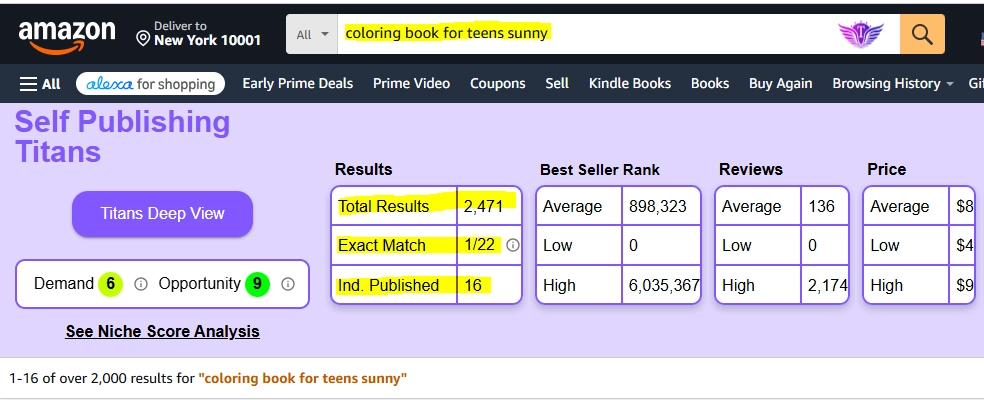
The third keyword was:
“coloring book for teens suny”
Here is the data:
| Metric | Data |
|---|---|
| Estimated monthly search volume | 6,059 |
| Total competing products | 2,471 |
| Demand score | 6/10 |
| Opportunity score | 9/10 |
| Exact-match books on first page | 1 |
| Independently published books on first page | 16 |
| Average BSR | 898,323 |
| Average reviews | 136 |
| Average price | $8 |
This is where I would slow down before doing anything else.
The keyword shows an estimated 6,059 monthly searches and an opportunity score of 9/10.
Those numbers look interesting.
But the keyword itself is unusual:
“coloring book for teens suny”
Before creating a book around it, I’d want to understand exactly what people searching for this phrase are looking for.
Is “suny” a typo?
Is it related to a specific term, name, organization, or audience?
Is it a search pattern that Titans Pro has picked up from Amazon data?
Or is there another reason these words are appearing together?
This is a good example of why keyword research shouldn’t be reduced to looking for the biggest number.
The keyword may show strong estimated search activity, but if I don’t understand the search intent, I wouldn’t rush into creating a product.
The competition is listed at 2,471 products, with 16 independently published books appearing on the first page.
But the average BSR is much higher here at 898,323, while the average review count is only 136.
Those differences make this keyword particularly interesting to investigate further rather than immediately treating it as a publishing opportunity.
For me, this is exactly where a research tool can save time.
Instead of spending hours manually searching hundreds of keywords, I can quickly identify keywords that deserve a closer look and then investigate the actual Amazon results myself.
Why I Don’t Look at Search Volume Alone
When I research a KDP niche, search volume is one piece of the puzzle.
It’s an important piece, but it isn’t the entire puzzle.
For example, all three keywords above show estimated monthly searches above 5,000.
All three also have an opportunity score of 9/10.
If I only looked at those two numbers, the three niches might appear almost identical.
But once we look deeper, the picture changes.
The competition levels are different.
The number of exact-match books is different.
The number of independently published books is different.
The average BSR is different.
The average review count is different.
And, perhaps most importantly, the search intent behind the keywords may be very different.
That’s why I like looking at several data points together.
What These KDP Research Numbers Actually Mean
If you’re new to KDP research, some of these numbers can be confusing.
Here’s how I think about them.
Search volume
Search volume gives you an estimate of how frequently people are searching for a keyword.
It’s useful for identifying potential demand.
But search volume isn’t the same thing as book sales.
Someone can search for something without buying a book.
So I use search volume as a signal, not a promise.
Competing products
This gives you an idea of how many products are competing around the keyword.
Lower competition can be interesting, but competition isn’t automatically bad.
A market with many products may also indicate established demand.
The important question is whether there is room for another useful, differentiated product.
Exact-match books
This helps show how many books on the first page are closely targeting the exact keyword.
If there are very few exact-match books, that can be worth investigating.
But again, it doesn’t mean Amazon will automatically rank a new book simply because the keyword isn’t heavily represented in titles.
Independently published books
This is another useful signal because it lets you see whether independent KDP publishers are already appearing in the search results.
I want to study those books.
If independent publishers are succeeding in a niche, I can examine what they’re doing and determine whether I can create something useful and differentiated.
BSR
Best Sellers Rank can give you an indication of how books are performing relative to other books in their Amazon category.
I don’t treat one BSR number as a precise sales forecast.
Instead, I use it as another piece of evidence when examining the books on the first page.
Reviews
Reviews can tell you something about how established the books are and can also provide valuable information about customer expectations.
I especially like reading reviews because they can reveal problems customers have with existing products.
Those problems can sometimes point toward opportunities for creating a better product.
Price
Price gives you an idea of how the market is positioned.
If similar books are selling around $8–$10, for example, that gives you some context when evaluating your own potential product.
But I wouldn’t choose a price simply because it’s the average shown in the research.
The page count, format, content, quality, and positioning all matter.
How Titans Pro Helps With This Research
This is where I find a tool like Titans Pro from Self Publishing Titans useful.
The biggest benefit for me isn’t that it somehow tells me:
“Publish this book and you’ll make money.”
No research tool can reliably make that promise.
Instead, it helps me get through the initial research stage much faster.
I can start with a keyword, look at estimated search volume, examine competition, and see additional information about the books appearing in the results.
That gives me a much better starting point than randomly searching Amazon and trying to make decisions based on whatever I happen to see.
And as the examples above show, two keywords with similar search volume can tell very different stories once you look at the other numbers.
That’s the part I find valuable.
Titans Pro helps turn a broad KDP research process into a more structured decision-making process.
From there, I still want to look at the actual Amazon results.
My KDP Niche Research Process
Here’s the process I use.
Step 1: Start with a keyword
I begin with a topic or keyword that looks relevant to the type of book I want to create.
Step 2: Check the demand
I look at estimated search volume and the demand information available in the research.
I’m looking for evidence that people are actually searching for the topic.
Step 3: Check the competition
I look at competing products and, more importantly, the actual books appearing on the first page.
Step 4: Study the books
This is where the numbers turn into real research.
I look at:
- Covers
- Titles
- Subtitles
- Interiors
- Page counts
- Prices
- Reviews
- Customer complaints
- Book positioning
- BSR
- Publication dates
Step 5: Look for an angle
I ask myself:
Can I create something genuinely useful that is different enough from what’s already available?
If the answer is no, I move on.
Step 6: Stop researching
This is probably the most important step.
At some point, research stops being research and becomes procrastination.
I don’t need perfect certainty.
I need enough information to make a reasonable publishing decision.
Then I need to create the book.
The Biggest Lesson From These Three Niches
Looking at these three keywords reminded me of something I’ve learned after years of publishing on KDP:
Good niche research isn’t about finding one magical number.
It’s about putting several pieces of information together.
The three keywords all show estimated search volume above 5,000.
All three show an opportunity score of 9/10.
But when we look at competition, exact-match books, independent publishers, BSR, reviews, price, and search intent, they’re not identical opportunities.
And that’s exactly why I prefer a research process rather than simply chasing high-volume keywords.
A research tool can help you find the data faster.
But you still have to interpret that data.
You still have to look at the books.
And you still have to decide whether you can create something worth publishing.
Want to Speed Up Your KDP Research?
If you publish low-content or medium-content books on Amazon KDP and want to spend less time manually digging through keywords and competition, you can take a look at Titans Pro.
I use it as a research and decision-support tool rather than treating its scores as guarantees.
Affiliate disclosure: I may earn a commission if you purchase through my link, at no extra cost to you.
The goal isn’t to find a keyword and immediately publish.
The goal is to find promising opportunities faster, investigate them properly, and then make a better-informed publishing decision.
And sometimes the most valuable result of niche research is discovering that a keyword isn’t worth your time.
That’s a useful decision too.
Because a few minutes spent rejecting a weak idea can save you hours creating a book nobody needs.
My Recommended KDP Masterclass 2026 💡
KDP Masterclass By Self Publishing Titans
I absolutely love this Masterclass because it’s one of the most up-to-date and practical KDP courses available. The creators aren’t just teachers — they’re real KDP publishers who’ve earned over $300K in book royalties! 📚 I personally took this class and noticed a steady increase in my KDP sales over time. If you’re serious about growing your publishing business in 2026, this course is a total game changer.