How I Find Low-Competition KDP Niches That Actually Make Money
Most publishers fail on Amazon KDP because they choose the wrong niche. In this guide, I’ll show you exactly how I find low-competition niches that actually generate sales.
Many beginners make the same mistakes. They go after saturated niches, copy random ideas, and never validate demand. The result is simple: they publish books that don’t sell.
My Simple KDP Niche Research Framework
I follow one core rule when evaluating any niche:
- Decent demand
- Low competition
- Individual publishers already succeeding
If a niche meets all three criteria, I consider it. If not, I move on.
Free Method for KDP Niche Research
You don’t need paid tools to get started. I begin with two free Chrome extensions:
Once installed, go to Amazon and switch the marketplace to the United States. You can choose any state, such as New York, to get accurate data.
Start by typing a seed keyword like “puzzle book,” “coloring book,” or “math workbook.”
If you prefer watching instead of reading, you can check out the full video where I walk through everything step by step. Watch it below 👇
🎁 Download 15 FREE KDP Interior Templates
Save time and create beautiful low-content books faster with these 15 ready-to-use KDP interiors — completely free! Perfect for journals, planners, and activity books.
Step 1: Analyze Existing Listings
Look at the books that appear in the results. Focus on:
- Books with good reviews
- Books with a strong Best Sellers Rank (BSR)
These are clear indicators that the books are selling. You can also use these listings to discover new niche ideas.
Step 2: Use Long-Tail Keywords
Instead of targeting broad keywords, use long-tail variations.
With AMG Suggestion Expander, you’ll see additional keyword ideas like:
- Puzzle book for toddlers
- Puzzle book for kids ages 10–12
- Murder mystery puzzle book
For example, if you search “puzzle book for toddlers,” you might see thousands of results. That suggests high competition, so you need to dig deeper.
Look for books that:
- Have fewer reviews
- Still maintain a decent BSR
This usually indicates newer books that are already selling.
Step 3: Identify Hidden Opportunities
While browsing, you may discover niche variations like:
- Logic puzzles for kids
- First puzzle books
- Activity-based puzzle books
These are often overlooked niches that don’t show up in basic search suggestions.
You can repeat the same process with other keywords like “workbook.”
For example:
- “Workbook for 3-year-olds”
- “Third-grade math workbook”
If the number of results is relatively low, it may indicate lower competition. However, always evaluate the quality of the listings before making a decision.
Evaluating Competition the Right Way
Even if a niche shows demand, it doesn’t mean it’s easy to enter.
Ask yourself:
- Are there big brands dominating the results?
- Do the top books have hundreds or thousands of reviews?
- Are the covers and interiors high quality?
If the answer is yes, the niche may be too competitive for beginners.
Some niches have strong demand but require:
- High-quality books
- Professional covers
- A budget for Amazon ads
👉 Related Post: How I Make Money with Amazon KDP: My Simple, Repeatable System
Using a Paid Tool (Optional)
If you want to speed up your research, you can use a paid Chrome extension like Titans Pro.
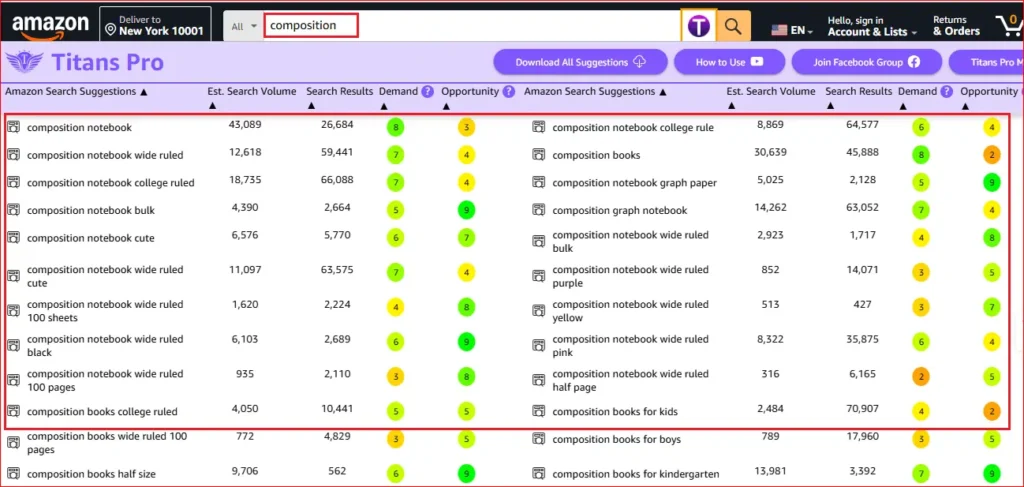
This tool provides:
- Search volume
- Number of results
- Demand score
- Opportunity score
I usually look for:
- Opportunity score close to 9
- Demand score above 5
This helps quickly filter promising niches.
Deeper Keyword Analysis
One advantage of paid tools is deeper keyword insights.
For example, a keyword like “workbook for kindergarteners” might show:
- Moderate demand
- Good opportunity score
- Manageable number of results
However, you still need to manually check:
- Book quality
- Number of reviews
- Competition level
Sometimes a keyword looks good on paper but is highly competitive when you analyze the listings.
Example of a Good Niche
During research, you might find something like:
“Puzzle books for teens (ages 12–16)”
This type of niche can work because:
- Search demand exists
- Competition is relatively lower
- Books with fewer reviews are still ranking
When you see independently published books with low reviews and decent BSR, it’s a strong signal that the niche has potential.
Why Manual Research Still Matters
Even with paid tools, you should always:
- Review listings manually
- Check covers and interiors
- Analyze reviews and rankings
Niche research takes time, but it’s worth it. Creating a book requires effort, and choosing the wrong niche leads to wasted time and disappointment.
KDP Niche Validation Checklist
Before choosing a niche, ask:
- Are books actively selling?
- Do some books have low review counts?
- Are the covers average (meaning you can improve)?
- Is there room to compete?
If the answer is yes, you can move forward.
Common Mistakes to Avoid
Most beginners:
- Target random niches
- Ignore competition
- Rush into publishing without validation
This is why most KDP books fail.
👉 If you want a complete beginner-friendly system that walks you through everything—from niche research to publishing and getting your first sales—check out my KDP course. I’ve broken it down step by step so you can follow along without confusion. 👉 Learn My Full KDP System (Step-by-Step)
Final Thoughts
Finding a profitable KDP niche isn’t about luck. It’s about following a clear process, validating demand, and making informed decisions.
Take your time, analyze properly, and focus on niches where you can realistically compete.
If you do that consistently, your chances of success increase significantly.
My Recommended KDP Masterclass 2026 💡
KDP Masterclass By Self Publishing Titans
I absolutely love this Masterclass because it’s one of the most up-to-date and practical KDP courses available. The creators aren’t just teachers — they’re real KDP publishers who’ve earned over $300K in book royalties! 📚 I personally took this class and noticed a steady increase in my KDP sales over time. If you’re serious about growing your publishing business in 2026, this course is a total game changer.